If you’ve ever felt like your decisions are based more on gut instinct than clear thinking, then a SWOT analysis is the tool you need. It works for any business challenge or decision, and it will sharpen how you think about your next move. Let’s break it down in more detail.
WHAT IS SWOT?
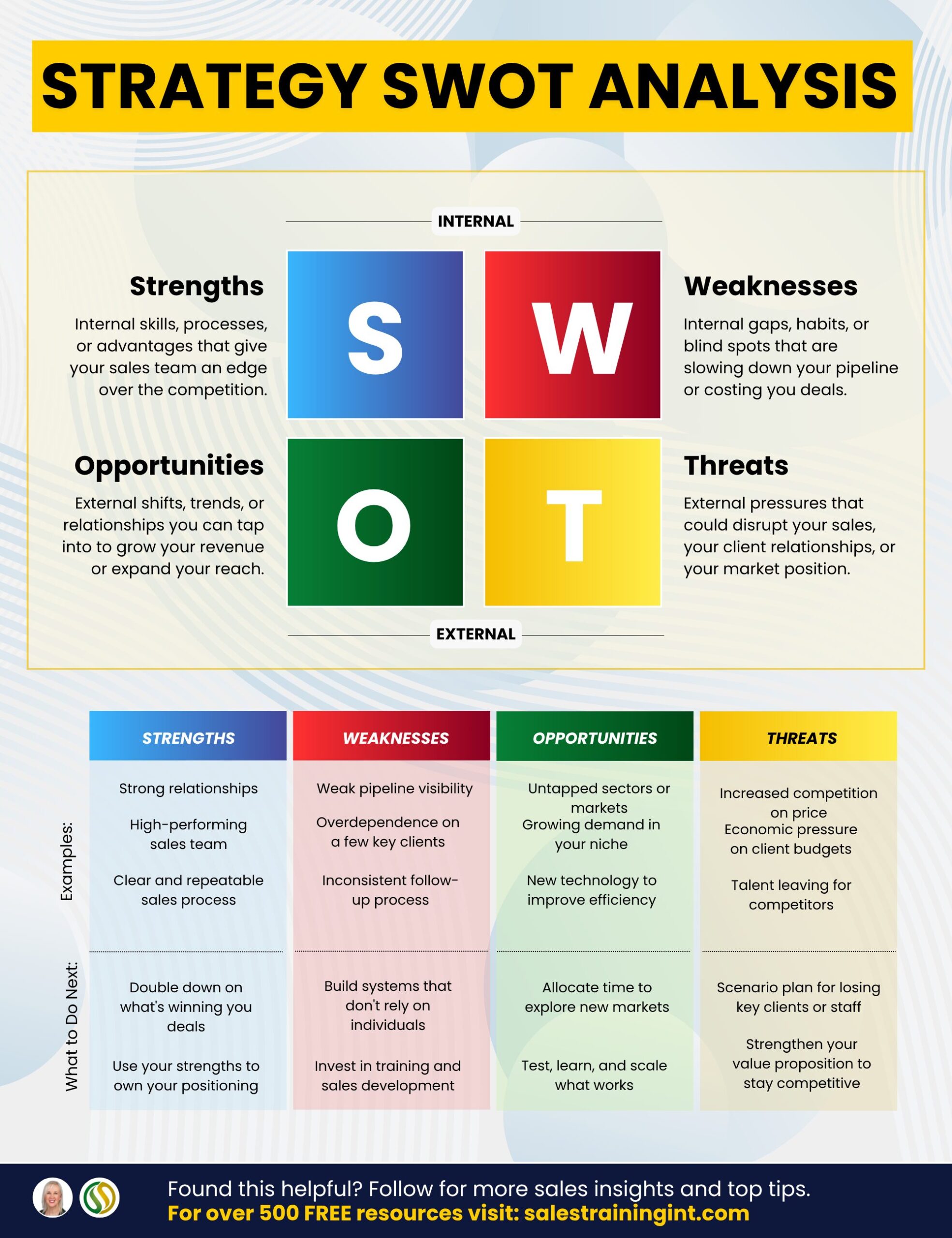
SWOT stands for Strengths, Weaknesses, Opportunities, and Threats.
The key thing to understand is the axis Strengths and Weaknesses are internal. They’re inside your business. Opportunities and Threats are external – they come from the market, the economy, your competitors.
You’re not just listing things randomly. You’re separating what you can control from what you can’t and that distinction is where the real thinking happens.
THE FOUR QUADRANTS OF A SWOT
Strengths
What gives you an edge? Think: a product no one else has, high-performing results.
Weaknesses
Where are the gaps? over-reliance on a handful of clients, inconsistent follow-up process.
Opportunities
What’s shifting in your favour externally? New markets, growing demand in your sector, technology you haven’t fully used yet.
Threats
What could disrupt you? Increased price competition, budget pressure on your clients, or your best people being poached by competitors.
Now let’s see it in action in a few difference scenarios.
SWOT for SALES
Imagine you’re a sales leader. Your team hits target most months, but you’ve noticed new business is drying up – you’re mostly selling to existing accounts.
Strengths: Great account management, strong existing customer loyalty.
Weakness: Almost no new business prospecting – the pipeline is too dependent on existing clients.
Opportunity: A competitor has just exited your market, leaving their customers without a supplier.
Threat: Your pricing is being undercut by a cheaper online alternative.
The SWOT tells you: double down on prospecting now, while the competitor gap exists before the price threat gets worse. That’s your priority.
SWOT for BUSINESS STRATEGY
Now let’s say you’re a business owner reviewing your strategy for the next 12 months.
Strength: You have a loyal client base and a strong reputation in your niche.
Weakness: You’re too reliant on one geography or one sector.
Opportunity: Demand is growing in an adjacent market where your skills transfer.
Threat: Economic pressure is making your clients cut budgets.
The SWOT tells you: Diversify – move into the adjacent market before budget cuts hit your core clients harder. Use your reputation to open doors somewhere new.
SWOT for LEADERSHIP
A SWOT isn’t just for business strategy, it’s also a great too for leaders and it’s a brilliant tool for individual development too.
Strength: You’re a strong communicator and your team trusts you.
Weakness: You avoid difficult conversations – performance issues get left too long.
Opportunity: Your organisation is investing in leadership development right now.
Threat: Two high performers on your team are showing signs they’re disengaged.
The SWOT tells you to use the development investment to build your confidence with difficult conversations – before you lose the people you can least afford to lose.
WHAT TO DO NEXT
The SWOT only works if you act on it. So once you’ve filled in the grid, ask yourself four questions:
3. How do I use my strengths to capitalise on opportunities?
2. How do I fix my weaknesses before they become threats?
3. What’s the one priority this analysis is pointing me to? And when am I reviewing this again?
A SWOT isn’t a one-off exercise. The best leaders and sales teams revisit it on a regular.
If your team needs support with sales training, sales coaching, or more structured sales training programmes, you can explore our sales training courses, review our free sales training resources, or read more on how to ask great sales questions and consultative selling to strengthen your approach to discovery.
To get in touch with our team, call us on 01704 889325, email us at info@salestrainingint.com or fill in our online contact form.