Most salespeople know they should ask more questions, but many still move too quickly into explaining what they offer. The result is a pitch that sounds reasonable but does not connect strongly enough with the buyer’s real situation.
SPIN selling is a question-led sales method that helps buyers recognise their own needs through a structured conversation. In this guide, we explain what SPIN selling is, how the four question types work, and how sales teams can use the method in real B2B conversations.
What Is SPIN Selling?
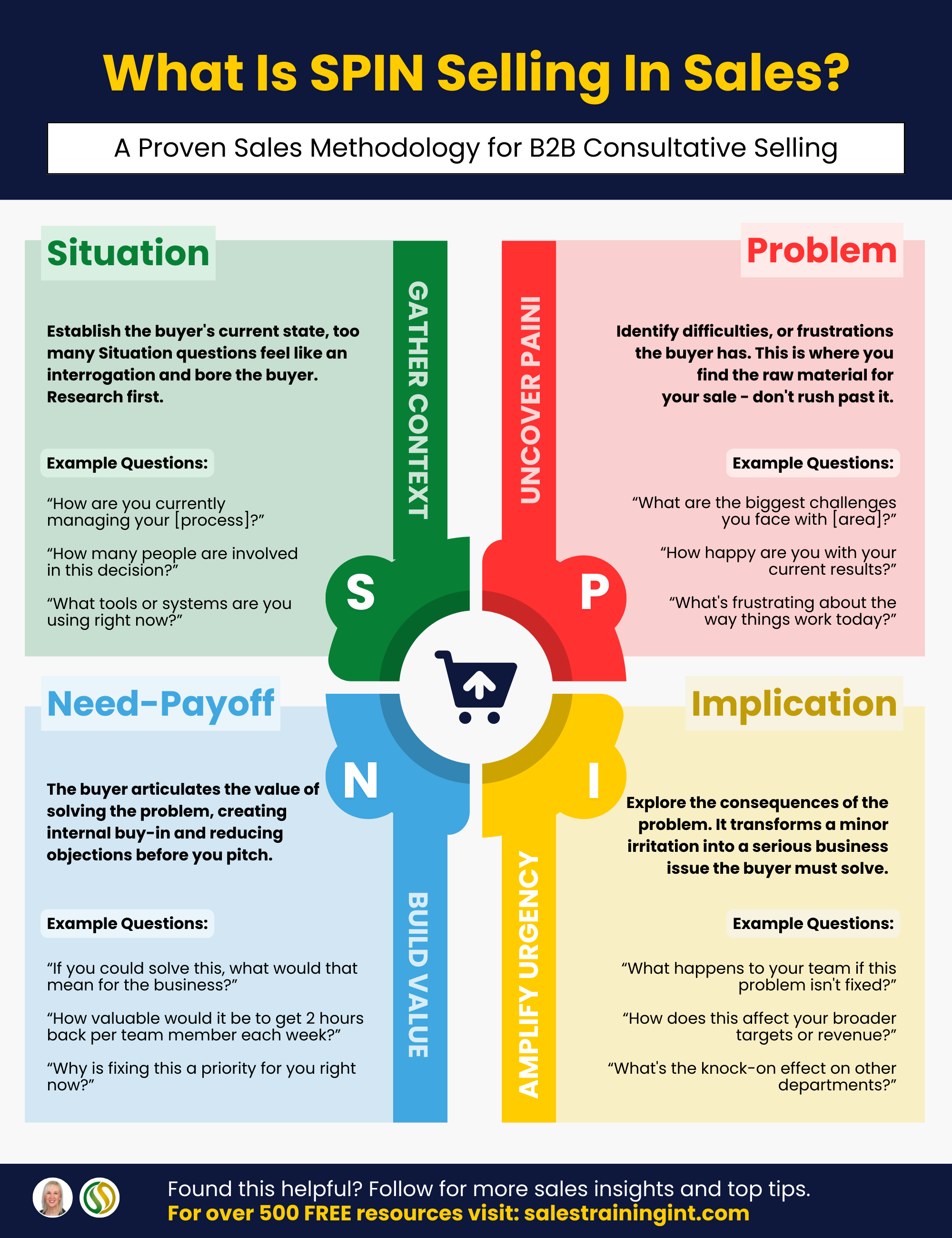
SPIN selling is a consultative sales methodology built around four types of questions: Situation, Problem, Implication and Need-payoff.
The method was developed by Neil Rackham and published in his 1988 book SPIN Selling. It came from research into more than 35,000 sales calls, looking at what successful salespeople did differently in larger, more complex sales.
The value of SPIN is that it gives salespeople a structure for discovery without turning the conversation into a script. Rather than telling the buyer what they need, the salesperson asks questions that help the buyer explore their current position, recognise problems and understand the value of solving them.
SPIN works best when it feels like a natural conversation. Used badly, it becomes a checklist. Used well, it supports better discovery, stronger sales conversations and a more consultative selling approach.
The Four SPIN Question Types
SPIN selling is built around four question types. Each one has a different purpose within the conversation.
| Question Type | Purpose | Example |
|---|---|---|
| Situation | Understand the current context | How does your team currently manage incoming enquiries? |
| Problem | Uncover difficulties or dissatisfaction | Where do deals most often stall in your current process? |
| Implication | Explore the impact of the problem | If response times stay as they are, what does that do to renewal conversations? |
| Need-Payoff | Help the buyer explain the value of change | If you could cut quote turnaround time, what would that free your team to do? |
Situation Questions
Situation questions establish facts and context. They help the salesperson understand what is happening now, how the buyer currently works and what systems or processes are already in place.
Example questions include:
- How does your team currently handle new sales enquiries?
- What process do you use to qualify incoming leads?
- Who is usually involved when a decision needs to be made?
The common mistake is asking too many of these questions. Buyers can quickly become frustrated if the conversation feels like basic fact-finding, especially when some of the information could have been researched beforehand.
Problem Questions
Problem questions uncover areas of difficulty, frustration or dissatisfaction. This is where the conversation starts to move from background information into real sales opportunity.
Example questions include:
- Where do deals most often slow down in your current sales process?
- What are your team finding hardest when speaking with new prospects?
- What tends to stop opportunities from moving forward?
The mistake here is asking problem questions too broadly. A vague question often gets a vague answer. Good problem questions are specific enough to help the buyer think clearly about what is not working.
Implication Questions
Implication questions explore the impact of the problem. They help the buyer think about what the issue is costing in time, revenue, morale or missed opportunity.
Example questions include:
- If those deals keep stalling, what impact does that have on monthly targets?
- How does inconsistent follow-up affect your conversion rate?
- What happens if the team continues handling discovery calls in the same way?
This is where many average salespeople stop short. They uncover a problem but fail to explore why it matters. Without implication, the buyer may understand the issue but still lack urgency to change.
Need-Payoff Questions
Need-payoff questions help the buyer describe the value of solving the problem. Rather than the salesperson stating every benefit, the buyer begins to articulate why a better outcome would matter.
Example questions include:
- If your team could qualify leads more accurately, how would that affect pipeline quality?
- What would improve if managers had more consistent sales conversations to review?
- If your reps felt more confident handling objections, what difference would that make?
The common mistake is making need-payoff questions sound too leading. They work best when they invite the buyer to think, not when they are used to force agreement.
A Worked Example
Here is how SPIN selling might sound in a short B2B conversation about sales training.
Salesperson: How are your team currently handling discovery calls?
Buyer: Everyone has their own style. Some are strong, but others rush through it.
Salesperson: Where does that create the biggest problem?
Buyer: We end up with weak opportunities in the pipeline because the need has not been properly qualified.
Salesperson: If those weak opportunities stay in the pipeline, how does that affect forecasting?
Buyer: It makes forecasting unreliable and wastes manager time.
Salesperson: If the team had a more consistent way to ask discovery questions, what would that help you improve?
Buyer: We would have better qualification, cleaner pipeline reviews and more confidence in the deals we are working.
The conversation stays natural, but each question has a clear purpose.
SPIN Vs Other Sales Methodologies
SPIN is often used alongside other sales methodologies rather than replacing them.
The BANT framework is mainly used for qualification. It helps salespeople assess budget, authority, need and timing. SPIN is more conversational because it helps uncover the need in the first place.
The MEDDIC sales process is often used in more complex B2B sales where qualification, decision criteria and internal process need close management. SPIN can support MEDDIC by improving the quality of discovery.
The Challenger sales model focuses on teaching the buyer something useful and challenging their thinking. SPIN works differently because it uses questions to help the buyer reach a clearer understanding of their own situation.
These methods are not rivals. In the right setting, they can support each other.
Does SPIN Selling Still Work?
SPIN selling still works, but it needs to be used with judgement. Buyers are more informed than they were when the book was first published, so basic fact-finding questions can feel unnecessary if the salesperson has not prepared properly.
The strongest parts of SPIN remain highly relevant. Implication and need-payoff questions reflect how modern consultative selling works because they help the buyer understand the impact of a problem and the value of change.
The method fails when it is treated as a rigid checklist. It works best when salespeople understand the purpose behind each question type and use them naturally within the conversation.
How to Train Your Team On SPIN
Sales teams do not improve their questioning skills by reading a framework once. Practice is what turns SPIN from theory into behaviour.
Call reviews are useful because managers can hear whether reps are asking meaningful questions or moving too quickly into presentation mode. Role play also helps, especially when it is based on real opportunities rather than generic scenarios.
Coaching matters because the quality of questioning improves over time. Salespeople need feedback on how they ask, how well they listen and whether they are linking the conversation back to buyer needs. Our guide on the value of sales coaching explains why that support is so important for lasting change.
SPIN Selling FAQs
What does SPIN stand for in sales?
SPIN stands for Situation, Problem, Implication and Need-payoff. These are the four question types used to guide a sales conversation from context through to value.
Is SPIN selling still relevant today?
SPIN selling is still relevant when it is used as a flexible discovery framework. It is especially useful in B2B sales where the buyer needs to understand the impact of a problem before making a decision.
What is the difference between SPIN selling and consultative selling?
SPIN selling is a questioning framework that supports consultative selling. Consultative selling is the wider approach, while SPIN gives salespeople a practical way to structure discovery.
Is SPIN selling suitable for small or transactional sales?
SPIN can feel too detailed for simple, low-risk purchases. It is usually more useful in considered sales where the buyer needs to explore problems, consequences and value before moving forward.
Final Thoughts
SPIN selling helps salespeople structure better conversations through Situation, Problem, Implication and Need-payoff questions. It is most effective when reps use the framework naturally, listen properly and focus on helping buyers understand their own needs.
At Sales Training International, we deliver in-house training that helps teams build stronger questioning skills through practice. Explore our sales training courses or call our team on 01704 889325, email us at info@salestrainingint.com, or fill in our online contact form to discuss support for your sales team.