In sales, your most valuable asset isn’t your products or your pitch deck, it’s your relationships. The ability to remember a client’s name, recall a conversation from months ago, follow up at exactly the right time, and keep every sale moving forward is what separates good salespeople from consistent top performers.
However, the human brain simply cannot keep track of everything, especially when you have to manage 50, 100 or even 200 contacts simultaneously. Deals will be at different stages, clients have different needs, and your inbox is overflowing. It’s simply impossible to manage this accurately without being overwhelmed. This is where a Customer Relationship Management (CRM) system becomes a useful and essential tool to salespeople.
In this blog we will break down:
- What a Customer Relationship Management (CRM) Is
- The Top Reasons Salespeople Should Use a CRM
- 6 of the Best CRM Systems for Salespeople
- How to Choose the Right CRM for You
What Is a CRM — And Why Should You Care?
A CRM is a software platform that helps you manage all your interactions with existing and potential customers. Think of it as a advanced 3-in-1 contact book, sales tracker, and sales management diary, all in one.
CRM’s allow you to:
- Store all client contact and business information safely in one place
- Track every email, call, meeting, and interaction with a client
- Monitor where every deal sits in your pipeline
- Set reminders and automate follow-up tasks
- Analyse your own sales performance with personalised data and reports
Besides these CRM benefits, it overall gives you complete control over your time, pipeline and sales.
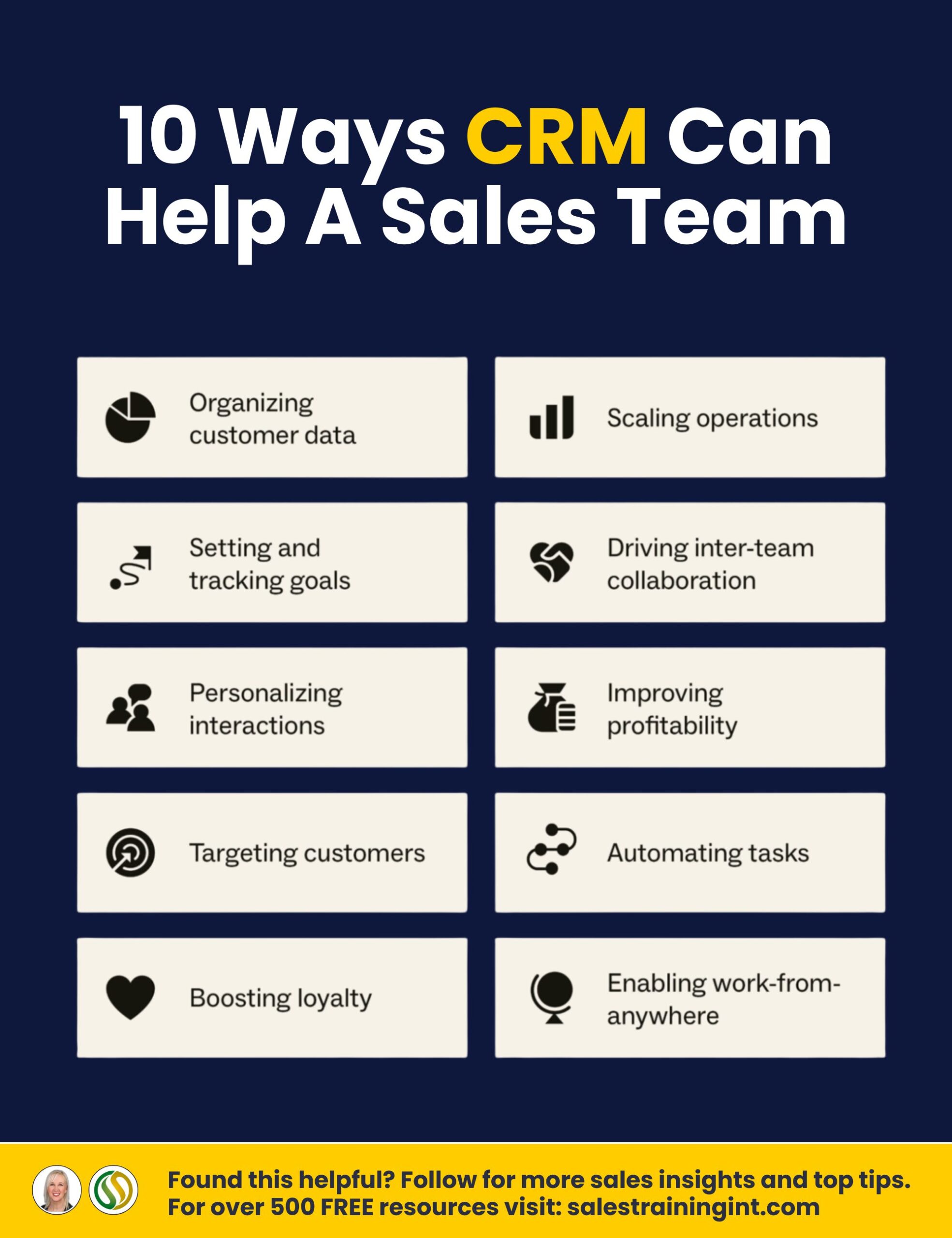
The Top Reasons Salespeople Should Use a CRM
1. On Top of Your Follow-Ups
Sales requires between five and twelve follow-ups with a client before the deal is closed, yet most salespeople give up after the first two attempts due to being forgotten.
Using a CRM actually helps you solve that problem entirely. You are able to use automated reminders, schedule meetings, and receive prompts the moment it’s time to reach back out and follow up with a client. Doing so means your clients will feel valued and nurtured, you will stay consistent, and overall close more deals and enhance your customer service
2. Fully Understand Your Pipeline
One of the most common challenges in sales is not really knowing how many deals you have, what they’re worth, or how likely they are to close. CRM’s give you instant clarity and insights into every deal, it’s stage, value, and what action needs to be taken next.
These insights help you plan and prioritise your day, become more strategic in the way you work by focusing your time on the deals that are most likely to close, as well as identifying where you need to put more effort in.
3. Build Deeper, More Personalised Relationships
Customers and prospects buy from people they trust. Trust is built through consistency, attentiveness, and feeling genuinely understood. A CRM stores every interaction you’ve ever had with a contact including what they have said, what they care about, and what challenges they have.
If you call up a client after months and reference a conversation they thought you had forgotten about, it doesn’t look good. Personal touch and is what builds loyalty and earns you referrals.
4. Manage Your Time More Effectively
Time is your most finite resource in sales. Every minute spent searching through emails, flicking through notebooks, or mentally trying to remember where a conversation left off is a minute not spent selling. A CRM centralises everything, so you spend less time hunting for information and more time having conversations that move deals forward.
5. Accelerate the Onboarding of New Salespeople
If your sales knowledge lives in your head or scattered across spreadsheets and notebooks, what happens when a salesperson leaves, or someone new joins? A CRM creates institutional memory. A new team member can step in and immediately see the full history of every account, understand client preferences, and continue relationships without wasting time.
6. Hold Yourself Accountable with Data
Top performers know their numbers. How many calls did you make this week? How many demos did you run? What’s your conversion rate from proposal to close? A CRM gives you access to real data about your own performance, so you can identify what’s working, spot patterns, and make continuous improvements rather than guessing.
7. Forecast More Accurately
Whether you’re a solo sales professional or part of a larger team, being able to forecast your revenue pipeline is enormously valuable. A CRM lets you apply probability weightings to deals and produce realistic revenue projections helping you plan, manage expectations, and avoid end-of-quarter surprises.
6 of the Best CRM Systems for Salespeople
Choosing the right CRM depends on your business size, budget, and the type of selling you do. Here are six excellent options worth considering:
1. Zoho CRM
Affordable all-in-one CRM for growing businesses.
- Free plan available — ideal for getting started
- AI-powered sales predictions and lead scoring
- Seamless integration with 40+ Zoho apps
2. HubSpot CRM
User-friendly CRM with powerful free tier features.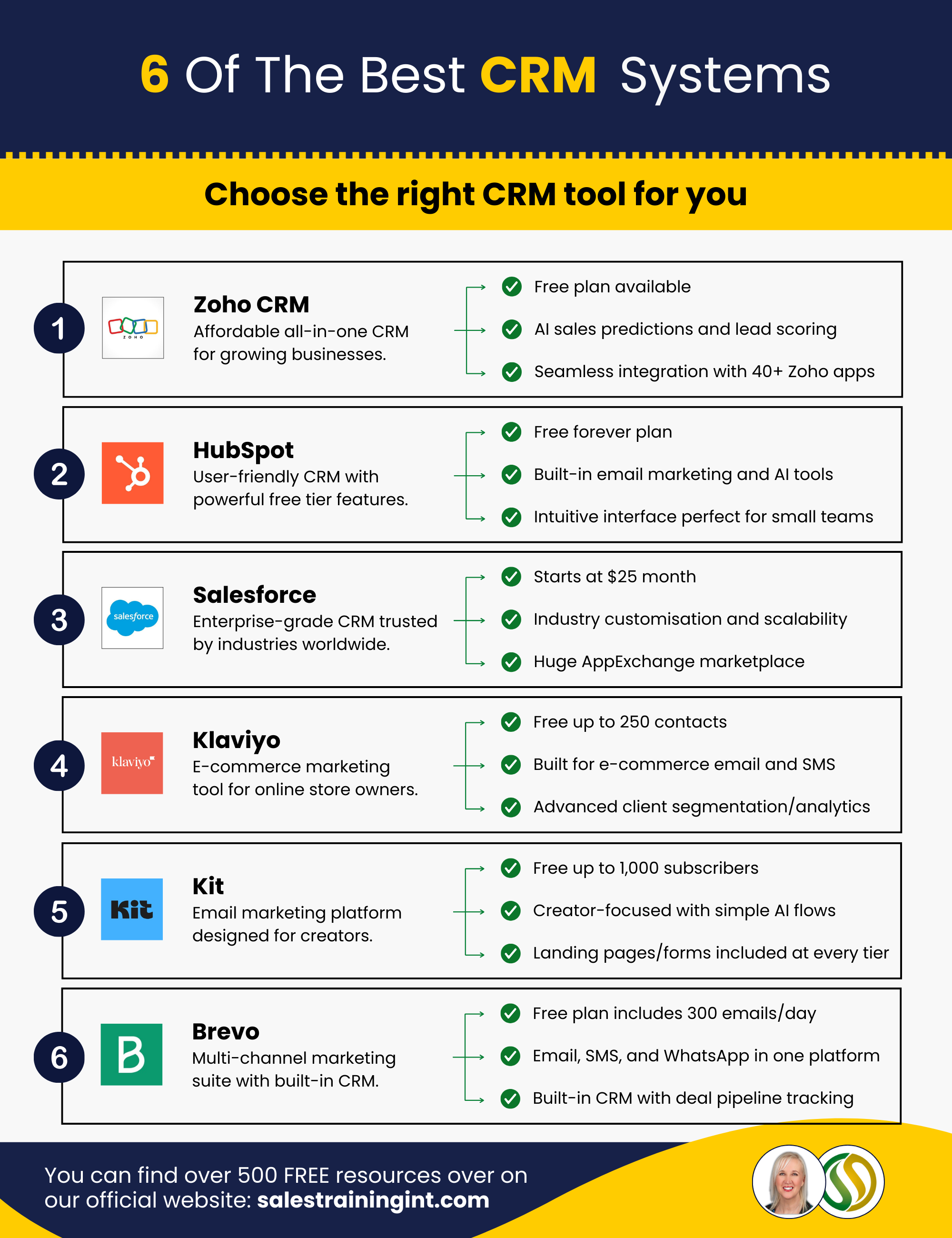
- Free forever plan — no credit card required
- Built-in email marketing and AI tools
- Intuitive interface perfect for small teams and solo sellers
3. Salesforce
Enterprise-grade CRM trusted by industries worldwide.
- Starts at $25/month with extensive customisation options
- Industry-leading scalability for growing businesses
- Huge AppExchange marketplace with thousands of integrations
4. Klaviyo
E-commerce marketing tool for online store owners.
- Free up to 250 contacts — great for small e-commerce businesses
- Built specifically for e-commerce email and SMS campaigns
- Advanced client segmentation and analytics
5. Kit (formerly ConvertKit)
Email marketing platform designed for creators.
- Free up to 1,000 subscribers
- Creator-focused with simple, effective AI-powered flows
- Landing pages and forms included at every pricing tier
6. Brevo
Multi-channel marketing suite with built-in CRM.
- Free plan includes 300 emails per day
- Email, SMS, and WhatsApp communication in one platform
- Built-in CRM with deal pipeline tracking
How to Choose the Right CRM for You
With so many options available, the key is to match the tool to your specific situation and challenges. Here are a few guiding questions that can help you decide on which tool is most suitable to your needs:
1. Are you a solo professional or part of a team? Solo sellers may find HubSpot or Kit more than sufficient, while larger teams might need the power of Salesforce.
2. What’s your budget? Both Zoho and HubSpot offer excellent free tiers that are genuinely useful — not just limited trials.
3. What industry do you work in? Klaviyo is purpose-built for e-commerce, while Salesforce offers deep customisation for more complex enterprise environments.
4. How tech-savvy are you? If you want something you can be up and running with in an afternoon, HubSpot or Brevo are great starting points.
Most platforms offer free trials or free tiers, so there’s no reason not to start experimenting. The best CRM is ultimately the one you’ll actually use consistently.
Sales is a profession built on relationships, consistency, and timing. A CRM is the tool that makes all three possible. It won’t close deals for you or guarantee income, but it will ensure you never miss the opportunity to.
Whether you’re brand new to sales or a seasoned professional looking to improve your customer relationship management process, investing time in a CRM system is one of the highest-leverage things you can do to improve your results.
Start by picking one of the tools above, you don’t have to spend any money just try out one of the free trials to get a feel of what a CRM can actually do for you. Begin logging in your contacts and conversations and within weeks you’ll realise why salespeople are using this effective tool.
A CRM records the conversation; it does not have it for you. That is where sales training pays off, because the notes in the system are only ever as good as the questions asked on the call.
Here’s a video on AI tools you can use in sales and marketing:
If you’re looking to build confidence in your sales conversations and relationships, our free sales resources are a good place to start. For expert advice, you can speak directly with our team on 0044 01704 889325, email us at info@salestrainingint.com, or fill in our online contact form to discuss how professional sales training can help you create clarity, momentum and better results.